
Native vs Hybrid vs Cross-Platform App Development: Which Should You Choose?
Building a mobile app in 2026 means choosing between three development approaches: native, hybrid, or cross-platform. With the mobile app market hitting $330 billion this year, making the right choice impacts your budget, timeline, and success. Let’s break down each option.
Understanding Your Options
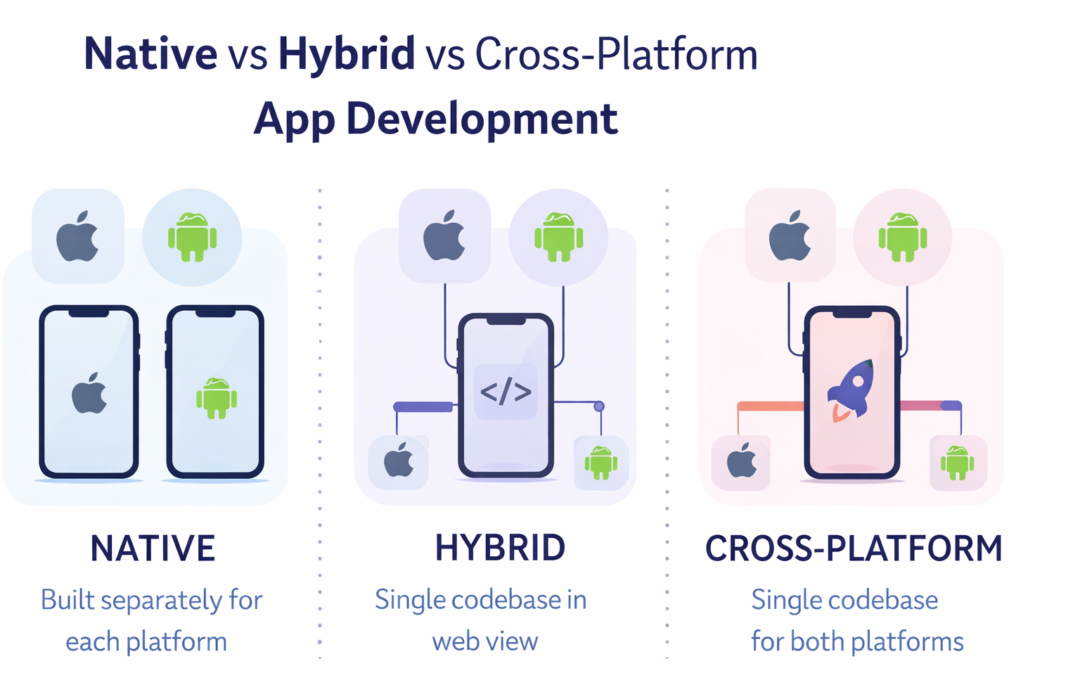
Native development means building separate apps for iOS (using Swift) and Android (using Kotlin/Java). You get maximum performance and full access to platform features, but you’re essentially building two apps. Companies like Snapchat and Instagram use native for their performance-intensive features.
Hybrid apps are web applications wrapped in a native container. Built with HTML, CSS, and JavaScript, they run inside a browser component on your phone. Think of it as a website disguised as an app. This approach is fastest and cheapest but offers limited performance.
Cross-platform development uses frameworks like Flutter or React Native to write code once and deploy everywhere. Unlike hybrid apps, these compile to native code or use bridges to native components, delivering near-native performance. Google Pay uses Flutter, while Microsoft Office mobile uses React Native.
The Cost Reality
Here’s where it gets interesting. Native development typically costs $100,000-$250,000 because you’re building twice—once for iOS, once for Android. Cross-platform cuts this by 30-50%, ranging from $50,000-$150,000 for both platforms. Hybrid is cheapest at $30,000-$90,000 but sacrifices performance and features.
A real example: A fitness tracking app cost $55,000 with React Native versus a $120,000 quote for native development. That’s more than half the price with comparable results.
Performance in 2026
The performance debate is essentially over. Cross-platform frameworks now deliver near-native performance for 90% of business applications. Flutter compiles to native machine code, while React Native’s new architecture eliminates legacy performance issues. Users can’t tell the difference in typical e-commerce, social media, or business apps.
Native still wins for gaming, AR/VR, and graphics-intensive applications requiring maximum performance. Hybrid remains the slowest option, suitable only for simple content apps.
Making Your Choice
Choose native if you’re building games, AR/VR experiences, or apps requiring cutting-edge platform features. The performance advantage justifies the higher cost only when you truly need it.
Pick cross-platform (Flutter or React Native) for most business applications. You’ll save 40-50% on costs, launch 40-60% faster, and maintain a single codebase. This is the smart choice for startups, e-commerce, social apps, and MVPs. Flutter holds 46% market share in cross-platform development, with React Native at 35%.
Go hybrid only for simple content apps, internal tools, or rapid prototypes with budgets under $30,000. The limitations outweigh benefits for anything complex.
Conclusion
In 2026, cross-platform development is no longer a compromise – it’s often the strategic choice. With proven performance, major company adoption, and significant cost savings, the burden of proof has shifted to justify native’s premium price. Start with cross-platform to validate your concept quickly, then optimize specific components if needed. Your wallet and timeline will thank you.