
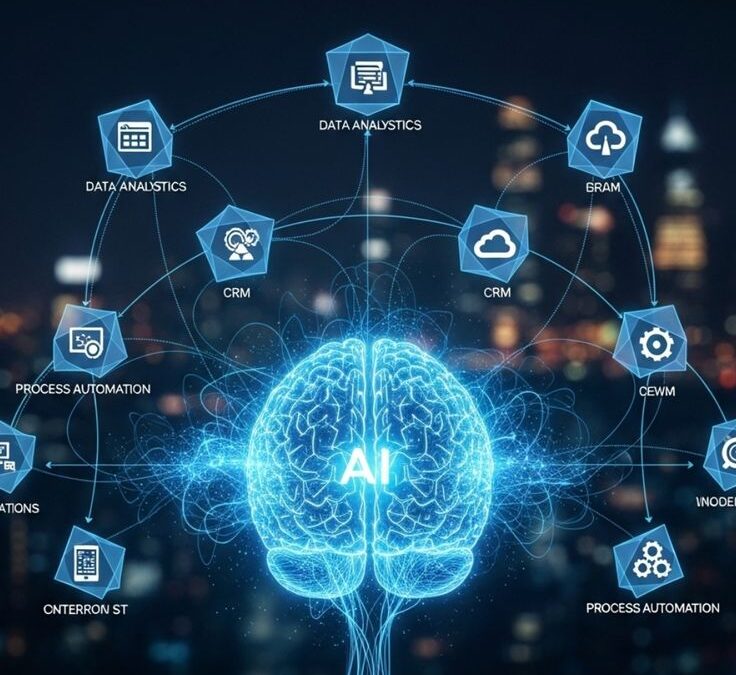
How AI & Automation Are Changing Software Development
The Numbers Don’t Lie — AI Adoption Is Skyrocketing
Before diving into the how, let’s look at the why. The data paints a compelling picture of just how rapidly AI and automation have taken root in software development ecosystems worldwide.
These aren’t speculative projections — they reflect real investment, real adoption, and real change happening on development teams right now. Companies that understand this shift are delivering software faster, with fewer bugs, at lower cost.
AI-Powered Code Generation: The New Developer Co-Pilot
One of the most immediate ways AI is reshaping software development is through intelligent code generation. Tools like GitHub Copilot, OpenAI Codex, Amazon CodeWhisperer, and Tabnine have moved well beyond simple autocomplete — they now suggest full functions, write boilerplate, and even generate tests automatically.
##### What This Means for Developers
Productivity Gains That Are Hard to Ignore
Developers using AI coding assistants report spending significantly less time on repetitive syntax and standard patterns. Instead of Googling the same Stack Overflow answers repeatedly, they get context-aware suggestions right inside their IDE. The result? More time for architecture, logic, and problem-solving — the parts that actually need a human brain.
Rise of “Vibe Coding” and Citizen Developers
An entirely new category of builder has emerged — people who can describe what they want in plain language and have AI translate it into working code. This phenomenon, sometimes called “vibe coding,” is democratizing software creation and fueling the rise of citizen developers who build functional tools without formal programming training.
Agentic AI: Software Development Goes Autonomous
The biggest development story of 2025 was undoubtedly the rise of agentic AI — systems that can operate with meaningful autonomy, understand intent, and take initiative without being given step-by-step instructions.
From Automation to Autonomy
Traditional automation followed rigid rules: if this happens, do that. Agentic AI goes further — it can analyse a development goal, break it into subtasks, write code, test it, handle errors, and even deploy — all with minimal human intervention. Enterprise platforms are already integrating these capabilities.
Multi-Agent Systems: The New Development Teams
Solo AI agents are giving way to multi-agent systems where specialised agents handle different parts of the software lifecycle — one for requirements analysis, one for coding, one for QA, and one for documentation. By 2028, analysts predict 38% of organisations will have AI agents embedded as permanent members of human teams.
Low-Code & No-Code: Building Faster, Together
Not every business problem requires a senior engineer and six months of development time. Low-code and no-code platforms powered by AI are changing the economics of software delivery, enabling teams to build, iterate, and ship in hours instead of weeks.
Adoption Is Already at Scale
Gartner and industry research consistently show that 70% of newly developed enterprise applications are expected to leverage low-code or no-code technologies. The global low-code market is set to grow from $45 billion in 2026 to over $101 billion by 2030 — a trajectory driven by demand for faster digital transformation.
Who benefits most
DevSecOps & AI-Driven Quality Assurance
Speed means nothing if security breaks down along the way. That’s why the integration of AI into DevSecOps — embedding security at every stage of development — is one of the most significant shifts the industry is experiencing.
Security Baked In, Not Bolted On
AI-powered tools now scan code for vulnerabilities in real-time as developers write it — catching potential security flaws before they’re ever committed to a repository. The DevSecOps market is growing at a CAGR of 28.1%, reaching $24.43 billion by 2029, reflecting just how central this practice has become.
The Human-AI Collaboration Model
Here’s something worth being honest about: AI isn’t replacing developers. What it is doing is expanding what each developer can accomplish. A developer augmented by AI tools can realistically do the work that previously required a team. The focus shifts from writing routine code to reviewing AI-generated output, thinking architecturally, and solving novel problems.
What This Means for Your Business
Whether you’re a startup building your first product or an enterprise modernising legacy systems, AI and automation in software development represent a genuine competitive advantage. The businesses winning in 2026 are those that have stopped asking “should we adopt AI?” and started asking “how do we optimise our AI strategy?”
At Globel Connect Telicomes, we build custom software, automation tools, CRM and ERP systems, and cloud-based applications with these very principles baked into every project. Our team stays at the cutting edge of AI-powered development practices — so your software doesn’t just work today, it scales intelligently for tomorrow.
Frequently Asked Questions
Ready to Build Smarter Software with AI?
Globel Connect Telicomes delivers custom CRM, ERP, automation tools, and cloud applications — built with modern AI-powered practices that scale with your business.
Talk to Our Software Team →